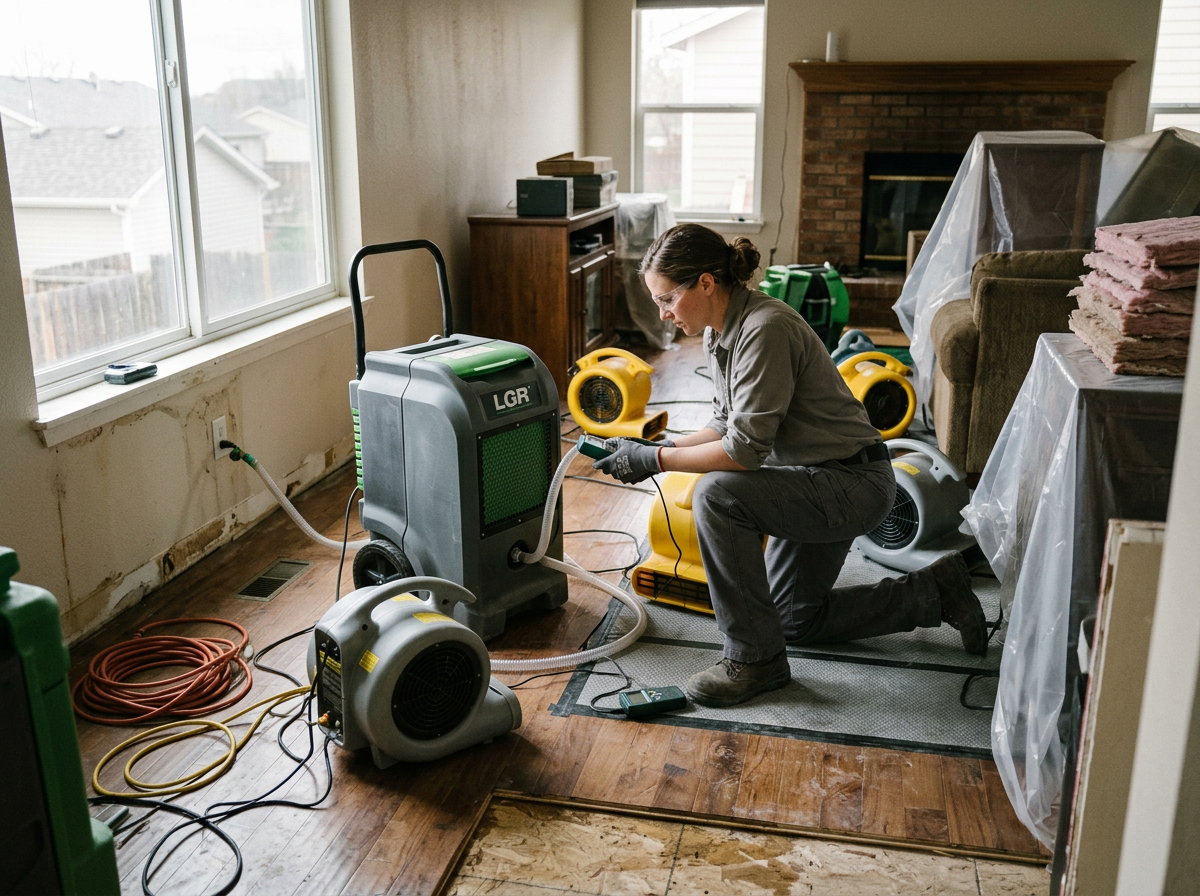
Water damage falls into three categories that dictate the entire restoration plan. Category 1 clean water from supply lines allows salvage of most materials if extraction begins within hours. Category 2 gray water from appliances or sump overflows requires removal of porous items like carpet padding and baseboards. Category 3 black water from sewage or spring melt demands full containment, disposal of affected drywall up to the flood line, and antimicrobial treatment before any drying equipment is placed.
Extraction starts with submersible pumps for standing water followed by truck-mounted vacuums that pull from under flooring and behind walls. Technicians then use pin and pinless moisture meters to map hidden saturation in framing and subfloors. Drying targets are 12-16 percent moisture content in wood and under 1 percent in gypsum. Air movers and dehumidifiers run until readings stabilize; low Denver humidity helps surface drying but leaves cavities wet unless directed airflow reaches them.
Drywall, insulation and particleboard must be cut out once moisture exceeds salvage thresholds, while hardwood can often be dried in place if caught early. The mold window opens after 48 hours in Denver’s semi-arid air because surfaces feel dry while cavities remain wet. Safety requires shutting off power to affected circuits, using PPE for Category 3 events, and ventilating swamp-cooler leaks that drip through ceilings when float valves fail at spring startup.
Documentation for insurance includes daily moisture logs, pre- and post-drying photos, equipment runtime records and a scope that lists every removed material. Adjusters in Capitol Hill and Baker routinely request these records because expansive bentonite clay under older foundations can turn a simple leak into structural movement if water sits against footings.
Technician insight
In Denver the thing that catches most people out with Water Damage Restoration is how fast surfaces dry while cavities stay wet at 5,280 ft. Homeowners in Capitol Hill and Baker often stop fans after two days because drywall feels dry, yet bentonite clay against old foundations keeps feeding moisture into framing and mold starts inside the walls.
Thaw Damage in an Englewood Ranch
A 1968 ranch in Englewood showed water along the garage wall after a February thaw. Meters revealed saturated sill plates and insulation in the exterior wall cavity from a frozen supply line that burst on the exterior wall. Extraction and targeted drying of the cavity prevented mold while the owners kept the original oak floors.
Water Damage Restoration Services We Offer
✓Basement Water Extraction
Removes standing water and hidden moisture from crawl spaces and basements where spring melt runs off frozen ground into pre-war brick homes.
✓Pipe Burst Restoration
Extracts water and dries wall cavities after frozen pipes thaw in unheated garages and exterior walls common in 1950s ranches.
✓Swamp Cooler Leak Repair
Extracts water and restores ceilings damaged when roof-mounted evaporative coolers leak at spring startup or autumn shutdown.
✓Category 3 Black Water Cleanup
Contains and removes contaminated water from sewage backups or heavy spring runoff that enters older stone foundations without drain tile.
✓Moisture Mapping and Drying
Uses meters to locate hidden saturation in subfloors and framing then sets drying targets specific to Denver’s low-humidity climate.
✓Structural Drying for Clay Soils
Monitors and dries foundations where bentonite clay swells against walls in neighborhoods like Washington Park and Highlands.
Water Damage Restoration Cost in Denver, CO
| Service | Typical Range | What Affects It |
|---|---|---|
| Category 1 extraction and drying | $800–$2,200 | Increases with square footage and number of affected rooms |
| Category 2 or 3 containment and disposal | $1,500–$4,000 | Higher when black water or sewage requires full PPE and disposal fees |
| Swamp cooler ceiling leak drying | $600–$1,400 | Depends on access to roof unit and extent of ceiling damage |
| Frozen pipe burst in crawl space | $900–$2,500 | Rises with depth of crawl space and amount of insulation removed |
| Daily moisture monitoring | $150–$300 per visit | Continues until readings reach target levels |
Ranges are typical for Denver, CO and confirmed with an exact written quote before any work starts.
How it works
- 1
Emergency Assessment
Arrive within hours, identify water category, and map affected areas with moisture meters.
- 2
Water Extraction
Remove standing water with pumps and vacuums then extract from under floors and behind walls.
- 3
Demolition And Removal
Cut out unsalvageable drywall, insulation and padding while protecting unaffected spaces.
- 4
Drying And Monitoring
Place air movers and dehumidifiers, then check daily until moisture targets are met.
- 5
Documentation Handover
Provide logs, photos and scope for insurance submission before final walkthrough.
Pricing
Pricing varies by water category, square footage, and access to cavities in older Denver housing stock.